
Are Fake Countdown Timers Legal? False-Urgency Rules for Email Marketers
 By Mehedi Hasan
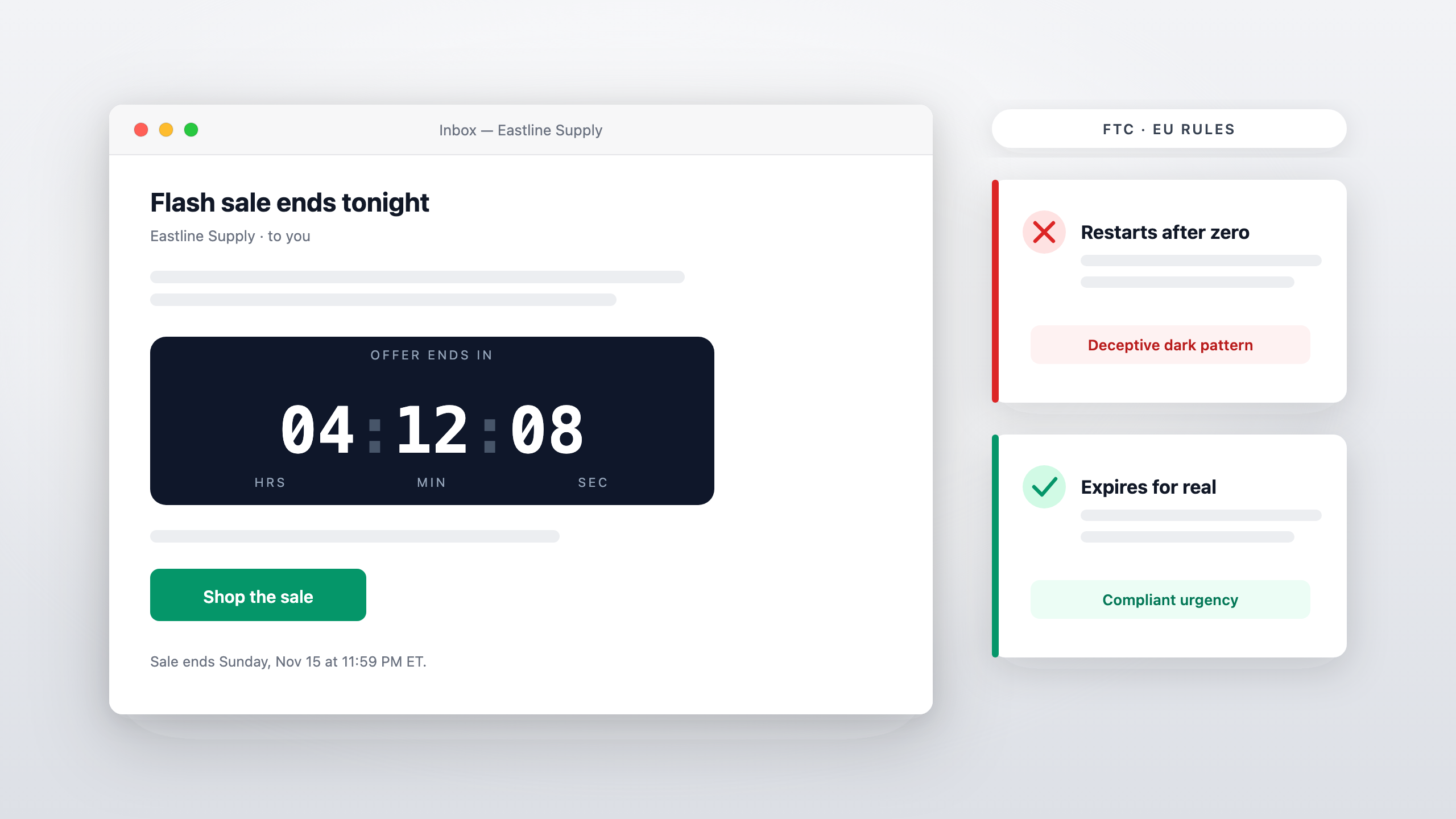
Short answer: a countdown timer is legal when the deadline behind it is real, and deceptive when it isn't. In the United States, the FTC names false countdown timers among the "dark patterns" its staff report examined as practices that "may violate the law" — deceptive practices under Section 5 of the FTC Act. In the European Union, falsely claiming that an offer is only available for a limited time sits on the short list of commercial practices that are unfair in all circumstances — no balancing test, no fine-print escape. This guide sets out both rules, the state-law direction of travel in the US, and a checklist for keeping timer campaigns on the right side of them.
What Makes a Countdown Timer "Fake"
The digits don't matter; the deadline does. A timer is fake when the deadline it displays is not the deadline the offer follows. The recurring patterns:
- The reset. A subscriber watches the timer hit zero, reopens the email, and the countdown has restarted. The deadline was never a deadline.
- The consequence that never arrives. The timer reaches zero and the discount still works, the cart stays open, the price never changes. The timer communicated an ending that didn't exist.
- The automatic extension. "Offer ends Sunday" quietly becomes "ends next Sunday," then the Sunday after that — without a genuine event causing the change.
- The invented constraint. Stock counters or "only 5 left" claims that have no relationship to actual inventory.
The design of the timer is irrelevant to the question. An elegant, on-brand timer counting down to a deadline that isn't real is the deceptive one; a plain text deadline that the offer genuinely follows is compliant. What regulators examine is the claim — "this offer ends" — and whether it's true.
The Rule in the United States
Section 5 of the FTC Act (15 U.S.C. § 45) prohibits "unfair or deceptive acts or practices in or affecting commerce." That statute is the FTC's main enforcement tool against misleading marketing, and it needs no new legislation to apply to a countdown timer — a timer is a claim about the future: that the offer ends, and roughly when. If the ending is invented, the claim is deceptive.
In September 2022, the FTC's staff made the agency's reading explicit in a report, Bringing Dark Patterns to Light, examining interface designs used to trick consumers. The press release lists countdown timers by name:
"countdown timers designed to make consumers believe they only have a limited time to purchase a product or service when the offer is not actually time-limited."
That sentence describes exactly the reset and no-consequence patterns above. The report is staff analysis rather than a rule, and the release notes these practices "may violate the law" — but the direction is unambiguous: a timer with a false deadline is the kind of design the FTC scrutinizes, and the agency has existing authority to act on deceptive practices without waiting for new rules.
The Rule in the European Union
The EU's Unfair Commercial Practices Directive (2005/29/EC, the UCPD) governs business-to-consumer commercial practices throughout a transaction — before, during, and after the sale. Its Annex I lists the practices treated as unfair in all circumstances, and one of them opens with a near-perfect description of a fake countdown:
"falsely stating that a product will only be available for a very limited time"
The full entry covers claiming limited availability or limited terms in order to push an immediate decision instead of an informed choice. Article 5(5) makes Annex I more than a guideline: it lists the commercial practices "which shall in all circumstances be regarded as unfair" — no case-by-case assessment of whether a consumer was actually misled. A timer that lies about limited availability falls there directly. The practical consequence for email marketers is simple — the same honest-deadline standard that keeps a campaign compliant with the FTC keeps it compliant in the EU. There is no jurisdiction where the fabricated deadline is the safe choice.
What About US State Laws?
Two US state privacy laws add a second, adjacent layer. Colorado's Privacy Act (C.R.S. § 6-1-1308) provides that agreement obtained through dark patterns — interfaces designed or manipulated with the effect of subverting user autonomy or choice — is not valid consent, and Connecticut's data privacy law (Conn. Gen. Stat. § 42-515) excludes agreement obtained through dark patterns from its definition of consent. Those provisions target privacy consent rather than sales urgency, so they don't directly govern a sale timer. They matter as context: US regulators are converging on the same view of deceptive interface design from multiple directions at once, which is a reason to keep deadline practices clean rather than a rule to memorize.
The Checklist: Keeping a Timer Legal
None of the rules above prohibit countdown timers. They prohibit lying with them. A compliant campaign is mostly a matter of process:
- Decide the real end date before you design the timer. The timer is the messenger; the offer policy is the decision. Set the end date where the campaign's terms live, not wherever the design ends up.
- Let the timer expire for real. When the deadline passes, the timer should show an honest ended state — zeros, a "this offer has ended" message, or a closing image — and the offer should actually be gone. Configurable expiry states exist for exactly this; Countdown Builder's expiry settings cover zeros, custom text, and images.
- Never reset a timer for the same subscriber. One real window per offer. If you want a second "last chance," it needs a second, genuine deadline — not the same deadline restarted.
- Match the duration to the decision. A 24–48 hour window suits a flash sale; a trial or enrollment window can legitimately run 7–14 days. A duration the subscriber can actually act within is both better converting and more defensible. The evergreen timer page includes guidance on matching window length to campaign type.
- Keep scarcity claims true. If the timer sits next to a stock counter or a "limited quantity" line, that line needs to be as real as the deadline.
- State the deadline in text too. "Ends Sunday, Nov 15 at 11:59 PM ET" in plain text costs nothing, survives blocked images, and documents that the email itself communicated a specific, real cutoff. The troubleshooting guide recommends the same redundancy for delivery reasons.
If you're building the timer for the campaign, the mechanics take minutes: pick a design, set the real end date, paste the snippet into your ESP. The email countdown timer builder walks through the three steps, and the free plan needs no credit card and adds no watermark.
FAQ
Are countdown timers in emails legal at all?
Yes. Fixed-deadline timers for real sales, genuine per-subscriber windows in automated sequences, and registration deadlines are all ordinary, compliant marketing. The legal question is never whether you used a timer — it's whether the deadline the timer displays is the deadline the offer actually follows.
What exactly counts as a "fake" timer?
A timer whose deadline doesn't govern the offer: one that resets for the same subscriber, reaches zero without the offer ending, gets silently extended, or backs up a scarcity claim that isn't true. The test is the truth of the deadline, not the polish of the design.
Is it still a problem if nobody actually bought because of the timer?
The concern is the claim, not the sale. A false "this offer ends" claim is deceptive when it's sent, which is why regulators examine the practice itself. Building campaigns where the deadline is real removes the question entirely.
Are evergreen countdown timers legal?
Yes, when the window is genuine. An evergreen timer gives each subscriber their own deadline — 48 hours from signup, say — and that window is real if it starts once, at a real trigger, and actually expires. An evergreen timer that quietly restarts for the same subscriber is the reset pattern wearing a different name.
The sale genuinely ends but new subscribers still see the email. What should the timer show?
An ended state, not a restarted clock. Configure the timer to display zeros, a "this offer has ended" message, or an image once the deadline passes, so a late reader gets the truth instead of a false countdown.
Final Thoughts
The rules across the US and EU land on the same practical standard: the deadline shown is the deadline that happens. That standard is also the commercially better one — the psychology of scarcity explains why urgency works, and the mechanism runs on trust. A subscriber who catches one fake timer discounts every timer that follows it.
So the compliance question and the conversion question have the same answer. Set a real deadline, let the timer expire honestly, and let urgency do the work it actually does. You can create an email countdown timer with custom expiry states in a few minutes and watch it behave correctly at zero — including on a free plan.
Related Guides
- The Psychology of Scarcity: Why Countdown Timers Actually Increase Sales
- Email Countdown Timer Not Working? 7 Causes and Fixes
- Evergreen Email Countdown Timers
- 15 Email Countdown Timer Examples (Annotated)
- Countdown Timer Expiry Settings
Last updated: November 2026. This guide is general information about marketing-compliance standards, not legal advice — for a specific campaign or market, consult a qualified lawyer. The FTC and EU descriptions reflect the sources cited as of this date; product behavior reflects Countdown Builder at the time of updating.
Written by Mehedi Hasan
Writer & Developer. He writes about email marketing, countdown timers, and campaign design.
Connect on LinkedIn